
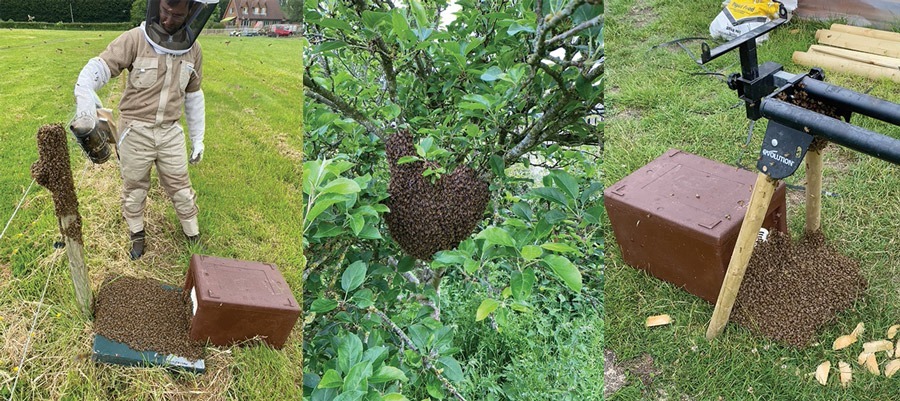
The snow that had covered the ground here in Manchester, UK, has melted, and temperatures are set to be above freezing for the foreseeable future. By which I mean, the next nine days that my weather app sees. And we all know how reliable they are. But still, I’m optimistic; the days are getting longer, it’s warming up, and spring is on the way. It may be a little early, but I’m going to write about swarming. In particular, let’s look at the various swarm prevention strategies and how effective they may be.
What Causes Swarming?
Several circumstances seem to coincide with swarming, but that does not confirm causation. I think, in truth, the cause of swarming is that honey bees are living creatures with a determination to reproduce. For the honey bee species, or any species, that’s a good thing. They have been at it for 20 million years or so, and it seems to have been very successful. The bees are simply following their programming, which is coded into the DNA in every one of their cells.
Swarming is the primary means by which honey bee colonies reproduce at the super-organism level1. In evolutionary terms, a successful swarm establishes a new colony, thereby ensuring the survival and genetic propagation of the bee population. Just as individual organisms reproduce, a honey bee colony replicates itself by sending out a swarm containing a portion of the worker bees and the original queen or a newly raised queen.
Genetics
Certain subspecies of honey bee are known to be more “swarmy” than others. Brother Adam referred to the “extremely difficult to control” urge to swarm in carniolan bees, and studies have shown that some breeding programmes have reduced the swarming tendency in some lines. My co-author of the book, Healthy Bees Heavy Hives, uses queens from Ivan Nielsen and can testify that they are much less likely to make swarm cells than the mongrel type of bee that his father used to keep. However, there is much more to swarming than genetics.
Queen Pheromones
The queen produces pheromones that help maintain colony cohesion. A declining queen pheromone signal, typically due to aging or overcrowding, can trigger swarm preparations2. So, that boils down to two separate factors that play a role in swarming; the age of the queen and the size of the colony. Older queens are more likely to swarm, as are larger colonies.
Brood Nest Congestion
High bee density and a lack of available comb cells for brood rearing increase the likelihood of swarm impulse. A fascinating chart on Randy Oliver’s website shows the colony dynamics of honey bees according to Lloyd Harris of Manitoba, Canada. In that location, most swarming occurs in June and July. This is the time when the queen is laying at her maximum rate and the amount of brood in the hive has peaked, as shown by the levelling-off of the dotted line on the chart. This state of “peak brood” often coincides with swarming.

Climate and Weather
In my area, swarming generally starts in late April and finishes by late June. Theoretically, at this time there is good weather and ample forage – factors which allow colonies to grow very strong. Bees rarely swarm when it is raining or the temperature is low. It sometimes seems to beekeepers that a period of several weeks of good weather followed by a week of rain causes masses of swarms when the sunshine returns.
It is the good conditions, combined with the time of year, that lead the bees to build swarm cells. The poor weather may cause a backlog of swarms – they would have gone earlier, but the rain stopped them – so it appears that it all happens at once when the sun comes out.
In the 2024 season, many of my colonies started swarm cells but later tore them down because the conditions were so poor in early summer. The cold and wet weather meant that the bees could not forage sufficiently to adequately feed the brood, and many colonies were on the brink of starvation. This is hardly desirable; it may reduce swarming, but it’s bad for the bees to be put under such stress.
Is Swarming Bad?
Back in the day of skep beekeeping, swarming was great, as that was the way beekeepers increased colony numbers. With modern equipment, things have changed as we can make increase without losing swarms. Generally speaking, the loss of a swarm will result in a smaller honey crop than if the swarm had not happened. For people who produce and sell honey, this is not good. An even worse situation is if the bees follow up with secondary (cast) swarms, in which newly emerged virgin queens leave with yet more workers, depleting the colony greatly.
However, as anyone who has observed a prime swarm leaving will testify, it is an incredible experience. Despite my efforts to limit swarming, it still happens, and I don’t really begrudge the loss of the odd swarm every so often. We may be able to steer the bees in a certain direction, but we are not their masters. If I kept bees in a residential area I would be more concerned, as I wouldn’t want to deal with complaints from neighbours.
Reducing The Urge to Swarm
1. Genetics
I have been using breeder queens from “non-swarmy” stock for many years, and I do believe that this has resulted in bees that are less prone to make swarm cells than the average local bee. However, if I’m honest, about half of my colonies do try to swarm at some point, although it does vary from year to year. I know that I can purchase queens that are less inclined to swarm, but I would rather make the majority of my queens than buy them. This is not an ideological thing, I just love raising queens. It is possible through selective breeding to minimise the swarming impulse3.
The challenge for me is that during swarm season my queen rearing has only just begun, and at that point I may not have spare queens. I therefore leave a single open queen cell in colonies that swarmed so that they can raise a new one. In these cases, I’m allowing bees that swarmed to make the next queen, so I’m not selecting for lower swarming. What I often tell myself is that I will re-queen those colonies at the end of summer, but it doesn’t often happen. I’m going to try to get some cells made quite early in 2025, so that I can add them to any swarmed colonies in May, which should be a step in the right direction.
2. Re-Queening
Many commercial beekeepers re-queen their colonies annually, and it would be quite rare to find queens in the summer in production colonies that are in their third season. Some of this will be to do with productivity. Many queens begin to run out of steam as they age, so even if they don’t swarm, the honey crop is lower than when she was younger and laying a larger brood nest. Younger queens produce more pheromones than aging queens and are less likely to swarm4.
There are different approaches to beekeeping, and many work well, so each must find their path. David Wainwright, based in West Wales, runs over 2,000 colonies in various locations of the UK, and is a very successful bee farmer. He sets up an apiary with colonies of all the same age (and possibly all sister queens), moving them from nucleus boxes into hives. This whole set of colonies is then treated as a unit, and they follow a life-cycle. Once they get older, and production starts to fall, they are re-located to “retirement apiaries” and replaced with a new set of nucs. He does not re-queen the colony, he replaces it with a new one, headed by a young queen.
Other beekeepers routinely re-queen colonies by removing the old one and adding her young replacement. Not all queen introductions are successful, but the evidence that I have seen suggests that a hopelessly queenless colony is highly likely to be more welcoming of a new queen (mated, virgin, or cell). Moreover, using a push-in-cage seems to work better than other cages, especially on larger colonies. Finally, the state of the queen being introduced makes a huge difference to acceptance; she should ideally be a laying queen at least 28 days old5.
3. Routine Inspections
If you want to have a chance of preventing swarming, you have to regularly check the brood boxes of colonies during the swarm season. Most people aim for a 7 to 10-day period between inspections. During this time of rapid colony expansion, the main things I look for are:
- Are there eggs present?
- Is there space for the queen to lay?
- Is there space for the bees, once the current sealed brood emerges?
- Are there any swarm cells (normally at the bottom of brood frames)?
As far as swarm prevention is concerned, which means before they make queen cells, the goal is to ensure that brood nest congestion is avoided.
4. Space For The Bees
As colonies move into the rapid expansion phase of spring and early summer, it is important for the beekeeper to always be a step ahead of the bees. This means adding space for the bees that you see now, and for those you predict will be there in the next 10 days or so. Sealed brood stays sealed for about 12 days, so if you are inspecting every 7 to 10 days, 60 to 80% of that sealed brood will have become bees by the next visit.
I work on the basis that a frame of sealed brood will become two frames of bees by the next inspection. So, if I find four brood frames of sealed brood in the spring, I’m going to have to make sure that there is the equivalent of 8 brood frames of space available for bees, which is about 12 medium super frames (Langstroth). That’s just over one super of drawn comb, as bees don’t always see foundation frames as ‘space’. At this time of the season, in early summer, I am often adding one or two supers at every visit.
If I only have supers of foundation available, I tend to swap a few frames with the box of drawn comb below, and then the new box will go directly above the brood box (under-supering). Hopefully, being close to the heat generated from the brood nest means the foundation frames have a good chance of being drawn out by the bees. We generally under-super anyway, to provide space right above the brood. It also means that the capped supers are at the top and easy to remove.
5. Relieving Brood Nest Congestion
There are many ways to ensure that the queen has space to lay eggs in her brood nest. What they all amount to is removing frames of honey and sealed brood from the brood box and replacing them with empty combs. Anyway, here are some options:
(a) Frame swapping
This is what we tend to do, as it is simple and effective. When we find strong colonies in spring, with loads of bees and brood, we remove a frame or two of sealed brood. The remaining brood frames are pushed together, and a new frame or two is added to the edge of the brood nest. These can be drawn comb or foundation. As the season progresses and the colonies get really strong, we insert foundation frames between frames of brood. They are drawn out rapidly. This replacement of combs not only reduces one of the potential triggers to swarming, it also ensures that over a period of three years all combs have been replaced.
Depending on the colony and the hive type, sometimes the bees decide to store honey in the brood box, at the edges, but it can encroach into the space that we want to be used for egg laying. We use Langstroth boxes and only allow a maximum of two honey frames in the brood box, and one of pollen. Often it will be one of honey and one of pollen. For our bees, they need at least seven frames for brood. In a smaller hive, like a National, it would probably be nine frames of brood and two of stores.
The removal of brood from strong colonies relieves some swarming pressure. We use the ‘spare’ brood to make up nucleus colonies. As long as they have a frame of brood, a frame of stores, and some bees and a queen (or a cell, or eggs) they can get on with building a new colony. A study from 2021 highlights the importance of early-spring or pre-flow splits. By implementing this intervention before the main nectar flow, beekeepers can prevent swarm preparation during peak foraging periods6.
Occasionally, we will boost a small colony with a frame of sealed brood, but small colonies are often small for a reason, and I feel more comfortable using those resources to make new colonies rather than support weaklings. Another excellent use of frames of brood is to create cell builder colonies, for raising queens.
(b) Reversing boxes
Very few of our colonies go into winter with double brood boxes, but I know that the double brood configuration is popular in other countries. They start off in winter in the bottom box, and by springtime they are upstairs, with the bottom box nearly empty. A quick and obvious technique to carry out in spring is to reverse the boxes, moving the bees and brood to the bottom, with the space overhead.
We do quite regularly have a super underneath the brood box through the winter. When harvesting honey at the end of summer, if a super is partially full and/or largely uncapped, we often place it on the floor beneath the brood. The bees quickly move the honey around the brood as they make preparations for the winter. In the spring, we flip the boxes over, so the brood box is on the floor and the empty super is above, separated by a queen excluder in our case.
(c) Double brood then split
I know of several beekeepers who place a second brood box on top of a strong colony in late spring/early summer; a box of foundation frames, not drawn comb. This should be after the spring flow from oilseed rape, for example. Theoretically, the bees draw out new comb and the queen moves upstairs to expand her brood nest. This gives extra space and gets a box of combs drawn out, which is useful. My concern is that sometimes, in my experience, bees decide to use the upper box for honey, not brood.
Anyway, the next step is to split the colony in two. The bottom box, which is largely sealed brood and bees, is removed and made into a new colony at another apiary. It will be given a new mated queen. When people talk of ‘splits’ they often mean nucs, but this is a brood box split. Meanwhile, the old queen remains in the old hive, but at this stage she has no sealed brood. This gives the beekeeper a window of opportunity to treat with oxalic acid (by sublimation usually) to ensure that mite levels are kept low for the summer. She will be re-queened later in the season.
(d) Demaree
I have written about the original Demaree, based on the article in the American Bee Journal by George Demaree many years ago. It is a swarm prevention method to be used before the bees make swarm cells. Many people wrongly use the term Demaree to refer to almost any vertical split. However, the original idea was to provide laying space for queens of strong colonies before they make swarm preparations. It is not even a split; the colony stays in one piece. The hive is rearranged somewhat, but there is still one queen, one entrance, one colony.
George Demaree’s strategy was to keep the colony strong, and therefore capable of bringing in a large honey crop, while relieving brood nest congestion. He said, “As I have already intimated, my plan of preventing swarming, and entirely preventing increase, is accomplished by one single manipulation right at the commencement of swarming. Only one hive and its outfit is used for each colony. Any system that requires a divided condition of the colony, using two or more hives, is not worthy of a thought.”
He continues, “I begin with the strongest colonies and transfer combs containing brood from the brood chamber to an upper story above the queen excluder. One comb containing some unsealed brood and eggs is left in the brood-chamber as a start for the queen.”
So, the upper brood chamber with most of the brood will attract nurse bees upwards. The brood will all have emerged within 21 days, creating another cycle of young bees, which will head downstairs to tend to the brood there. The queen is initially given a large space to lay up, and she gets on with it. If supers are needed, they go between the two brood boxes, above the excluder. The result should be that the colony will not swarm, it stays very strong, and plenty of honey is harvested. The upper brood box will become a full extra-large super, which will be very heavy.

R.O.B Manley did not like the system, claiming that it was wrong for our incredibly changeable weather conditions. I think he was using foundation in the bottom box, which would not be drawn out if the weather turned cold and wet. Others baulk at the heavy lifting involved. There is also the drone issue. Any drone brood moved upstairs will result in drones being trapped above the excluder. It’s possible to provide an upper entrance for drones using a drone escape in an eke or directly into the box. Hopefully most will fly off during inspections, so it may not be a big deal anyway.
(e) Checkerboarding
This technique to proactively dissuade the bees from making swarm cells in favour of building comb and storing honey was advocated by Walt Wright. My friend, Michael Palmer of Vermont, used to have lengthy arguments about it on beekeeping forums. He was very definitely not a fan. As Mike is a beekeeper that I trust, I am inclined to side with him on this one.
However, like most things in beekeeping, the checker boarding method has its followers. Some say it’s great, others the opposite. This is how beekeeping is. Different people solve problems in different ways. Something that works well for me and my bees may not work at all for somebody else. We have to find our own path.
There is a small book on the subject called Swarm Management with Checkerboarding by White, Hunt, and Bannister, which covers the topic in detail as practised by a group of beekeepers in Oxfordshire, England. The idea is to have super frames alternating between stored honey and empty comb, which creates a checkerboard pattern. This breaks up the ‘honey ceiling’ above the brood nest, which queens are often reluctant to cross, allowing for rapid spring expansion upwards. To understand more, you could read the book or search for articles by Walt Wright, who was nothing if not confident in this method.
In Summary
Many factors come together to create a strong colony of honey bees that is ready to swarm. Most beekeepers will be keen to prevent swarming to increase their chance of a good honey crop. The main ways to do this are by selective breeding of queens from low swarming stock, regular inspections during the swarm season, and provision of ample space for bees and brood in good time. As you can tell from this article, there are many ways to relieve brood nest congestion and hopefully persuade the bees to expand and collect honey rather than make cells and head for pastures new.
References
- Seeley, T. D. (2010). Honeybee Democracy. Princeton University Press.
- Winston, M. L. (1987). The Biology of the Honey Bee. Harvard University Press.
- Ruttner, F. (1988). Biogeography and Taxonomy of Honeybees. Springer-Verlag.
- H Hauser, Y Lensky. The effect of the age of the honey bee (Apis mellifera L) queen on worker population, swarming and honey yields in a subtropical climate. Apidologie, 1994, 25 (6), pp.566-578.
- Introduction and early performance of queen bees – some factors affecting success by John Rhodes and Doug Sommerville 2003. Rural Industries Research and Development Corporation, New South Wales Agriculture, publication No 03/049.
- Smith, J. (2021). A Study of Swarming Behavior in Apis mellifera. Journal of Apicultural Research, 60(2), 210–221.

Non-Treatment Sanity Check – The Walrus and the Honey Bee


Leave a Reply to WalrusCancel reply