
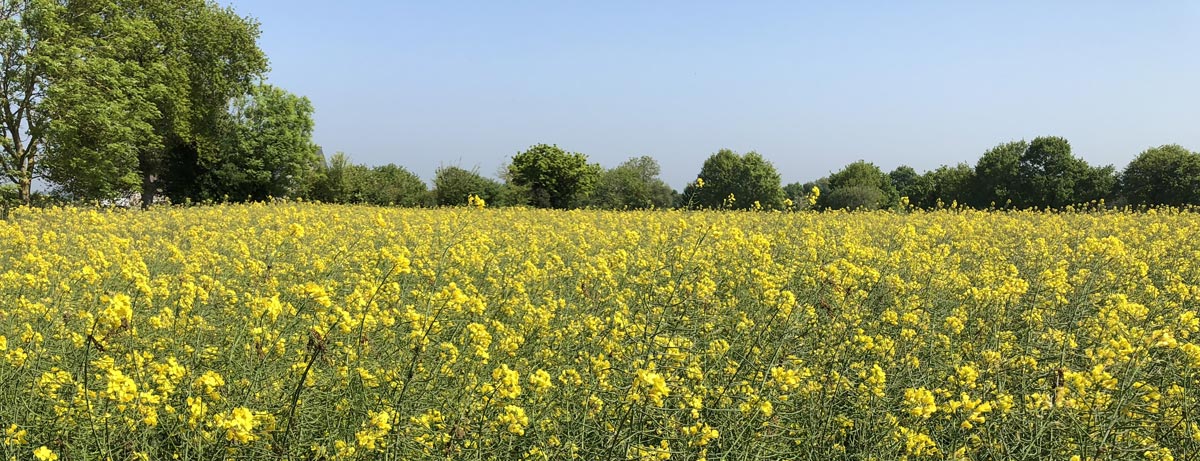
There was a time, not so long ago, that no oilseed rape (OSR) was grown in the UK. Much has changed in the past 50 years. When it first arrived, many beekeepers were astonished to find their hives plugged out with nectar as the bees went crazy on this new flow. They piled supers high and looked forward to extracting the astonishing bounty, only to find that it had all crystallised1. Lessons were learned. By the early 2010s, the UK grew so much of the stuff that we were the fifth-biggest exporter of OSR in the world.
In 2012, the UK grew 700,000 hectares of OSR, but it has been on the decline ever since. A decade on, we are now a net importer with a predicted area of just 280,000 hectares. In an eye-opening article, James Warner of United Oilseeds says that this move from net-exporter to net-importer will cost the UK economy £1 billion per annum2.

What’s so great about OSR anyway? I looked up a ranking of different cooking oils by ‘healthiness’ and got the following:
Extra Virgin Olive Oil, Avocado Oil
High in monounsaturated fats, which are linked to heart health. Contains antioxidants and bioactive compounds.
Caveat: Extra virgin olive oil has a relatively low smoke point, so it’s best for low-to-moderate heat cooking or finishing dishes. Avocado oil has a higher smoke point, making it versatile.
High-Oleic Sunflower Oil, Rapeseed Oil, Peanut Oil
High in monounsaturated fats and relatively stable under heat. Rapeseed oil is also high in omega-3 ALA and low in saturated fat.
Caveat: Highly refined versions may have fewer beneficial compounds compared to less processed oils.
Unrefined Sesame Oil, Walnut Oil, Flaxseed Oil
Rich in polyunsaturated fats (including omega-3 in flaxseed oil) and flavour.
Caveat: Low smoke points, best used raw or as finishing oils. Flaxseed oil is delicate and prone to oxidation.
High-Heat Refined Oils (e.g., Refined Olive, Corn, Soybean Oils)
Often less expensive and have neutral flavours, suitable for frying. Generally contain a mix of poly- and monounsaturated fats.
Caveat: Refining removes some beneficial compounds. Some, like soybean and corn oil, are high in omega-6 fats, which may be less ideal if consumed in excess relative to omega-3 intake.
Coconut Oil, Palm Oil
Higher in saturated fats, which can raise LDL cholesterol if consumed in large quantities.
Caveat: Coconut oil’s saturated fats differ somewhat from animal sources, and moderate use may not be harmful. Palm oil’s sustainability concerns are also a factor.
Partially Hydrogenated Oils (Trans Fats) and Highly Processed Oils
Trans fats are strongly linked to an increased risk of heart disease. Most health organisations recommend eliminating them from the diet.
Note: Many countries have banned or severely restricted partially hydrogenated oils.
Given its relative healthiness and high smoke point, it’s not surprising that rapeseed oil is the most consumed oil in the UK. As James Warner says:
UK Consumption of Rapeseed Oil
“Rapeseed oil is by far the most consumed edible oil in the UK, accounting for 40% of total oil demand. For context, it’s 13 times more important than olive oil. Of all the major edible oils (rapeseed, sunflower, palm, olive, soy), OSR is the only one that is commercially viable to grow in the UK. We used to be self-sufficient in OSR, meaning we had 40% food security on edible oils (which is already quite low!). However, after the decline in UK OSR production we have seen in recent years, today we produce just 20% of domestic edible oil consumption, relying on imports for the rest. This should be viewed as an emergency position from a food security point of view.”

OSR is not just indispensable to consumers of oils, spreadable butters, and mayonnaise, it’s an enormous help to arable farmers. Including oilseed rape in crop rotations can disrupt pest and disease cycles, improve soil structure, and enhance the yield of subsequent cereal crops. As a break crop, it helps maintain the overall health and fertility of the soil. And, of course, it benefits many pollinators, including honey bees. I understand that by bringing honey bee colonies to pollinate OSR, the crop yield can be boosted by over 20%; a win-win for growers and beekeepers.
The Downsides
However, there are downsides to the fields of bright yellow that many of us have become accustomed to. Oilseed rape is susceptible to various pests such as cabbage stem flea beetle (CSFB) and diseases, such as clubroot. These pressures can increase reliance on pesticides and fungicides if not managed through integrated pest management (IPM) strategies. Historically, neonicotinoid seed treatments helped manage pests, but these have been banned or heavily restricted in many places (including the UK and EU) due to their harmful effects on bees and other pollinators. Without these treatments, some farmers struggle to control certain pests effectively.
In 2013, the three main neonicotinoids were banned for all OSR uses both in the UK and the EU (at least in theory), and in all crops (again in theory) from 2018 onwards. It has become progressively more difficult to successfully grow OSR because of the CSFB. Lower crop yields can make growing OSR unprofitable, or not worth the risk, so other crops are grown instead. And that means that we now import half of the rapeseed oil that we consume.
Imported Rapeseed Oil
Most of our imported rapeseed oil comes from EU countries and Ukraine, with lesser amounts coming in from Canada and Australia. Strangely, since the war in Ukraine, production of OSR has actually increased slightly, and exports are managing to get out through the Black Sea3. And, guess what — Ukraine does not have a ban on neonicotinoids.

Emergency Derogations
The EU has done a terrible job of enforcing the neonicotinoid ban because of the loophole that is the ‘emergency derogation’. The principle of allowing derogations4 for the use of a specific plant protection product at a Member State level stems from Article 53 of Regulation 1107/2009. This permits them for limited and controlled use, where such a measure appears necessary because of a danger which cannot be contained by other reasonable means. In allowing such derogations, authorities consider five tests that must be met, namely:
• There must be a danger;
• There must be special circumstances which make it appropriate to derogate from the standard approach to authorisations;
• The danger must not be capable of being contained by any other reasonable means;
• An emergency authorisation must appear necessary because of that danger, and;
• An emergency authorisation may allow only limited and controlled use of the plant protection product.
Interestingly, regulations for organic growers specifically provide for the use of emergency derogations to allow the use of some pesticides in circumstances very similar to those referred to above for non-organic production systems. These derogations allow for the use of various pesticides, including copper-based products (e.g., oxychloride, sulphate, and Bordeaux Mixture), sulphur, paraffin oil, Spinosad, and pyrethrins. That doesn’t sound very organic to me. But I digress.
We Have Offshored Neonic Usage
In many EU countries, including those which export rapeseed oil to the UK, the emergency derogations have consistently been used to allow the use of neonics. The majority of neonic derogations are for sugar beet, but plenty goes on OSR too. So, the neonic ban has been a gut punch to UK growers of OSR, and we now import loads of rapeseed oil from countries that get around the rules. We have not reduced neonic usage; we have offshored it. Silly, right?


OSR Reboot
The stakeholders of the UK OSR industry have started to address the issue with an ‘OSR Reboot’. There is an acceptance that we are not going back to using neonic seed-treated OSR, so other solutions must be found. Apparently, a study6 has shown that giving the field a light cultivation straight after harvesting can reduce CSFB adult emergence from the soil by between 50-90%, by disrupting the lifecycle. It’s early days, but that’s something that farmers can do. It will be of benefit to neighbouring fields or neighbouring farmers, but if everyone plays their part, everybody gains.
It is a shame that the UK economy has taken such a big hit from the reduction of OSR grown here and the importation of rapeseed oil from places that use the very chemicals that caused it. In what world does that make any sense? However, I’m hopeful that the OSR Reboot will eventually bear fruit, or I should say, seed pods.
Notes
- Bob Halsey of Colsterworth Honey described this scenario to me, which he remembers from when OSR arrived in Lincolnshire in 1975.
- Some of the information in this piece is taken from the OSR Reboot article by James Warner of United Oilseeds. It is worth reading the full article.
- From “Ukraine and global agricultural markets two years later” – International Food Policy Research Unit.
- See article by Graham Brookes of PG Economics Ltd called “European Court ruling on neonicotinoids further highlights muddle created by ongoing EU regulatory inconsistency and dysfunction.”
- Source: Pesticide Action Network report called “Banned Pesticides still in use in the EU.”
- https://www.unitedoilseeds.co.uk/images/uploads/documents/Defra_report_on_NIAB_CSFB_study_2020-23.pdf


Leave a Reply to Healthy Bees, Heavy Hives – The Walrus and the Honey BeeCancel reply