
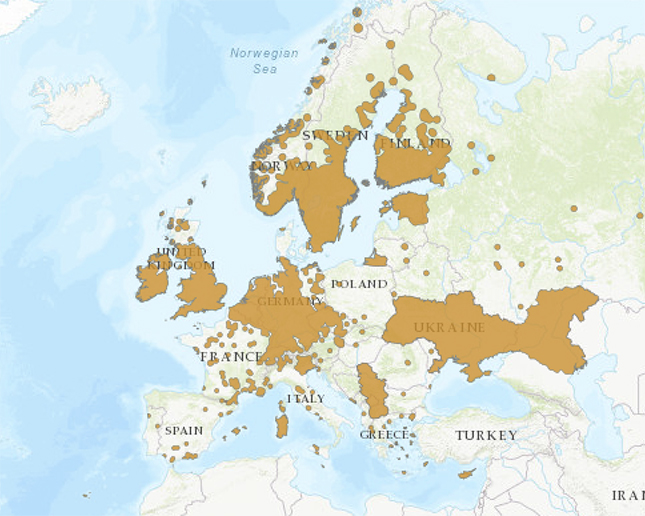
“Wild” honey bees have recently been classified as “endangered” in the European Union on the “Red List” of the International Union for Conservation of Nature (IUCN). This seems to have been based on a paper by Patrick L. Kohl & Benjamin Rutschmann (2025) which is not yet peer-reviewed and seems, to me at least, to be far from the most robust study ever conducted. However, it is good that somebody tried to look at, and make sense of, the population of free living honey bees in the EU, as they tend to be overlooked.
What is the IUCN?
I had to do a search on the IUCN, and here is what I found:
It is a global organisation founded in 1948 and based in Switzerland. It brings together governments, universities, NGOs and indigenous groups from more than 160 countries to set standards for biodiversity protection.
Best known for its Red List of Threatened Species, the IUCN provides the world’s benchmark for judging how close a species is to extinction – categories such as Vulnerable, Endangered, or Critically Endangered all come from its framework.
The Union is funded mainly by member dues, government grants and donor projects (EU, UN, World Bank, philanthropic foundations). Although not part of the United Nations, it holds official UN observer status and its findings underpin much international wildlife law.
Scientists regard it as the most authoritative and transparent global conservation body, even if its partnerships with industry (Shell, Holcim) sometimes spark debate.
IUCN Classification
Given the above, I would have thought that it would take something pretty convincing to move the status of unmanaged honey bees from “Data Deficient” to “Endangered”. Regardless, it is probably good news for the wild honey bees of the EU to have been moved up the scale. Theoretically, more funding and focus on conservation should follow, which is a good thing.

Recent Research Triggers Status Change
The new analysis by Patrick Kohl and Benjamin Rutschmann argues that wild honey-bee colonies across Europe are declining by around 56 per cent every decade, enough to qualify the species as “Endangered in the wild” under IUCN Red-List criteria. Their conclusion challenges the long-held assumption that Apis mellifera is so abundant under beekeeping that conservationists needn’t worry about it.
They gathered data from 698 known wild nests monitored in seven countries and treated each national dataset as part of one large “metapopulation” made up of two inter-linked groups:
• Managed colonies (in hives)
• Wild or free-living colonies (in trees or buildings)
They then asked: If no new swarms escaped from apiaries, how would the wild colonies fare on their own?
Using observed annual survival rates (as low as 10% in some forests) and an assumed average of two swarms per colony per year, they projected population change over ten years.
| Country | 10 Year Trend | IUCN Category |
|---|---|---|
| Germany, Switzerland | – 100% | Critically endangered |
| Spain, Poland | – 78%, -56% | Endangered |
| France, Luxembourg | – 38%, -41% | Vulnerable |
| England (S.E) | + 432% | Least concern |
| Median (EU) | – 56% | Endangered |
Only the south-east England population appeared self-sustaining; everywhere else, wild colonies would vanish within a decade without new swarms from beekeepers. If true, this means Europe’s “wild” honey bee population acts as a demographic sink, surviving largely because new escapees from hives top it up each year.
Yet some of these wild bees could carry locally adapted genes and natural resistance traits that managed stock may lack. Losing them could narrow the species’ evolutionary options in the face of varroa, disease, and climate change.
Metapopulation Model
An interesting quote from the study is: “There is generally no physical or genetic barrier between managed and wild honeybee colonies and, contrary to common misconception, no stable “breeds” of domesticated honey bees exist (Seeley, 2019). We therefore define wild Apis mellifera colonies based on their mode of living as colonies that are ownerless and unmanaged and live in their natural comb nests, at sites they have occupied themselves.”

I thought, based on the gospel of treatment-free beekeepers, that wild honey bees were this great untapped resource of “survivor bees” that would turbocharge varroa resistance if we could bring their genetics into managed colonies. Not according to these guys. No, in all places studied, apart from a small magical oasis in south-east England, wild bees appear to be dropping like flies.
Another quote: “The emigration of honey bee swarms from apiaries, though a natural process, can be regarded as a regular supplementation of the wild population from captive stock. Therefore, the relevant question for determining whether a cohort of free-living colonies deserves the attribute “wild subpopulation” and whether its conservation should be assessed is, “How would the population of wild colonies change over time if there was no immigration of swarms from managed colonies?”.
Reasons for Caution
Anyway, as I have said, there are some red flags to consider in this study – although the IUCN seems to have accepted it at face value, and presumably they know what they are doing. These are, as far as I can see:
1) The work is not peer-reviewed and should be treated as provisional.
2) Survival data came from small, mixed studies using different methods. These creatures are difficult to study, which is why the previous status was “Data Deficient,” and they had to scratch around for something – they probably did as well as anyone could without doing major new research.
3) The assumed “two swarms per colony” used in their model may over- or under-estimate true reproduction. I imagine the survivability numbers are quite sensitive to changes in this key variable.
4) “Wild” simply means unmanaged – many nests could be recent feral escapees rather than long-term self-sustaining populations.
5) The English dataset just looks so far out of step with the rest that I wonder if some bias crept in when sampling. Or maybe that part of England really is a wild bee paradise.
Threats to Wild Honey Bees
The IUCN lists the following threats to wild honey bee populations:
- Habitat loss and malnutrition, by agricultural practises or residential land development. One of the major limiting factors is represented by the decrease in forest habitats harbouring large trees capable of hosting cavities suitable for nesting free-living colonies (Requier et al. 2020)
- Pathogens, parasites, and predators. The varroa mite has been identified as the most likely cause of the demise of wild populations across Europe (Moritz et al. 2007, Jaffé et al. 2010), especially in combination with deformed wing virus (DWV). Also listed are nosema, Asian hornet, small hive beetle, and tropilaelaps (future threat).
- Possible effects of beekeeping practices. The importation, breeding, and movement of bees and queens come into the firing line here, although I can’t help thinking that the main impact of these has already happened.
- Pesticides, herbicides, and fungicides. So far, no specific study has been carried out on the effects of exposure of free-living colonies to pesticides. However, colonies nesting in intensive agricultural areas, where these compounds are intensively used, were found to have lower winter survival rates than colonies in semi-natural areas (Rutschmann et al. 2022).
Conservation Time
So, there you have it – some good and bad news for anyone interested in conserving wild honey bees in the EU. The new classification as “Endangered” should hopefully help with focus and funding. The fact that in so many countries the wild bees are dying out so quickly, numbers only being maintained by incoming swarms from managed colonies, suggest that there is not much time to act. The little quiet corners where few managed bees reside are very much worth conserving. In most places, as the study says, “There is generally no physical or genetic barrier between managed and wild honeybee colonies.” Just because they live in a tree does not mean they are different bees to the ones down the road living in hives.
Another blue touch paper having been lit, it’s time to relax and continue watching “Destined With You”, a K-Drama on Netflix. Have a lovely week ahead.

Feel free to add a polite comment!